
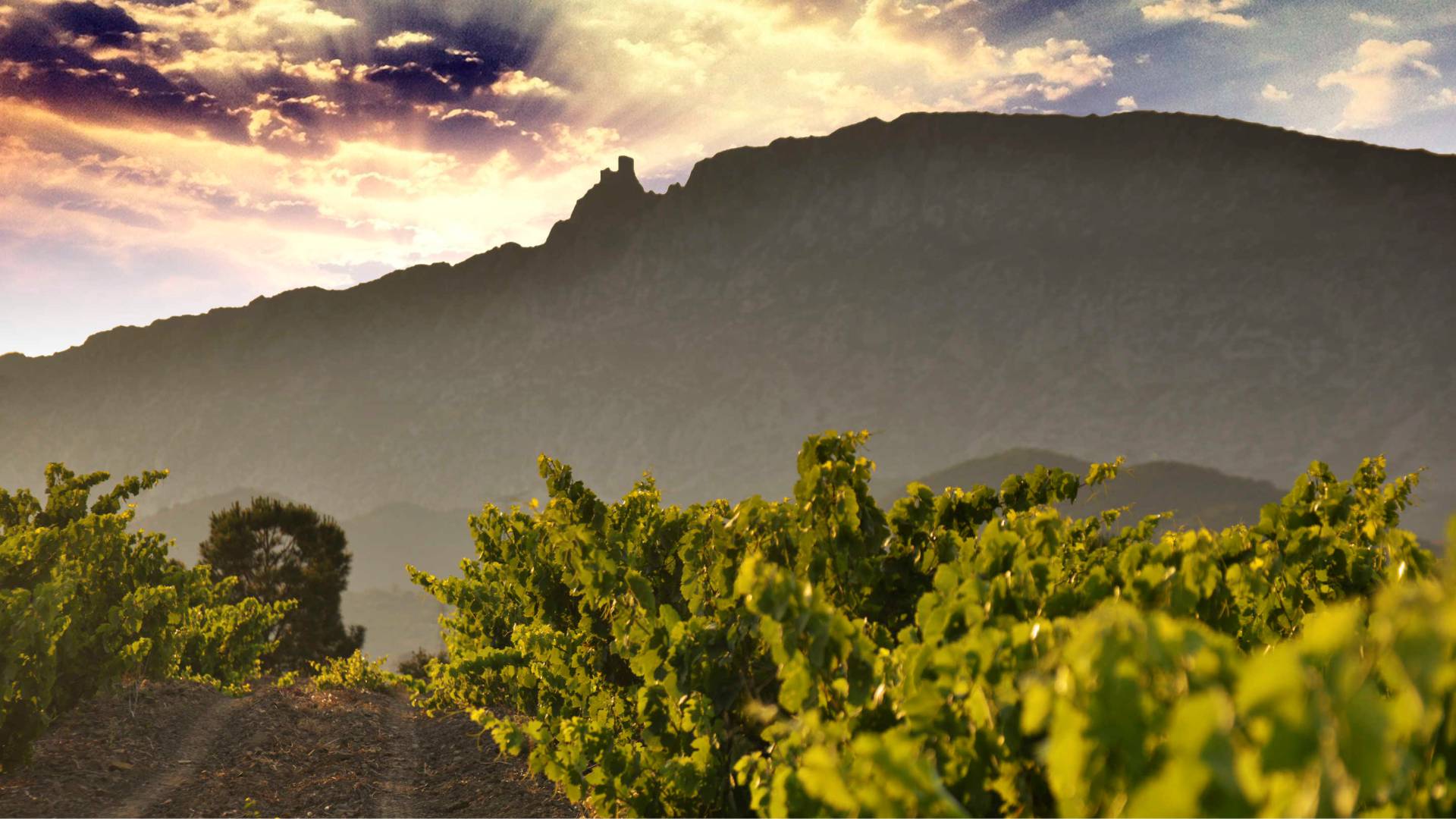
Since 1864, six generations of winemakers have been dedicated to perpetuating the ancestral agricultural tradition of this region of Roussillon and making the most of its exceptional terroir. In 1989, Pierre and Marie-Claude Fontaneil created Domaine Fontanel, the result of a union between their two families.
At the end of 2016, Elodie and Matthieu Collet took over the reins. You will continue to find the wines that define the Domaine’s identity.
Since 1864, six generations of winemakers have been dedicated to perpetuating the ancestral agricultural tradition of this region of Roussillon and making the most of its exceptional terroir. In 1989, Pierre and Marie-Claude Fontaneil created Domaine Fontanel, the result of a union between their two families.
At the end of 2016, Elodie and Matthieu Collet took over the reins. You will continue to find the wines that define the Domaine’s identity.
Elodie grew up near Lille. She met Matthieu while studying at the Higher Institute of Agriculture in Lille in the early 2000s. Internships in Bordeaux and Champagne, followed by a specialization in the wine industry at the School of Agricultural Engineering in Angers, led the young couple to unite around a shared passion: wine. Elodie worked for over 10 years in sensory analysis. Today, she brings a sensitivity honed through her experience and knowledge in the food industry.
Matthieu’s roots are in Picardy. A lover of the land and passionate about agriculture, he grew up in a family of livestock farmers. An agricultural engineer, he worked for a time in wine filtration in Alsace, Champagne, and Burgundy; then in industrial food processing, before choosing a career in winemaking out of passion. The couple returned to school and completed internships, studying to become oenologists at the Faculty of Pharmacy in Montpellier in 2015/2016 before settling in Roussillon. Their children, Antoine and Agathe, have joined them in this adventure and readily lend a hand.
Elodie grew up near Lille. She met Matthieu while studying at the Higher Institute of Agriculture in Lille in the early 2000s. Internships in Bordeaux and Champagne, followed by a specialization in the wine industry at the School of Agricultural Engineering in Angers, led the young couple to unite around a shared passion: wine. Elodie worked for over 10 years in sensory analysis. Today, she brings a sensitivity honed through her experience and knowledge in the food industry.
Matthieu’s roots are in Picardy. A lover of the land and passionate about agriculture, he grew up in a family of livestock farmers. An agricultural engineer, he worked for a time in wine filtration in Alsace, Champagne, and Burgundy; then in industrial food processing, before choosing a career in winemaking out of passion. The couple returned to school and completed internships, studying to become oenologists at the Faculty of Pharmacy in Montpellier in 2015/2016 before settling in Roussillon. Their children, Antoine and Agathe, have joined them in this adventure and readily lend a hand.
Terroirs
Clay-limestone
Composed of frost-shattered limestone and soils resting on a type of sandstone, with rounded pebbles up to 40 cm deep, it produces open wines with smooth tannins, combining finesse and personality.
The schistose marls
Formed on the collapse of the Fenouillèdes region, the Albian-Aptian schistose marls are interspersed with sandstone beds, often blackish in color. Composed of frost-shattered limestone resting on black marls and thick layers of clay, they produce wines that are tangy, mellow, and remarkably delicate.
PHILOSOPHY
We chose to settle in Tautavel because of the quality of the terroirs along the Agly River and its tributaries in Tautavel, Vingrau, and Maury. In Tautavel, in particular, the richness of the terroirs is exceptional. This diversity offers the opportunity to create exceptional blends and cuvées. But far beyond a profession, the wild atmosphere, the unspoiled nature between the sea and the mountains, and our desire to put down roots in a region rich in meaning and history drew us here. A valley where so many generations have worked the land, striving to bring out its very best.
Wine is the fruit of the earth, and today more than ever, environmental preservation is our daily concern. First and foremost, in the vineyard. We have decided to limit all cultivation to the bare minimum. Beyond labels, which sometimes get bogged down in absurd administrative constraints, we work with common sense and traditional farming practices. The earth speaks to us, the sky speaks to us, the plants bear witness, and we are at the heart of a balance as complex as it is fragile. We don’t claim to control nature, but simply to accompany it through its changes and help it bring us the very best, to produce the finest grapes possible. We adopt the most virtuous practices, primarily following organic farming standards, using inter-row cultivators for chemical-free weed control. We no longer use any active ingredients that pose a proven major risk to our environment or our health (no more products classified as CMR). We employ mating disruption techniques to eliminate the systematic use of insecticides. Our goal is therefore to produce very good, high-quality wine with the lowest possible environmental impact, even if it costs more, is riskier, and requires more work. Our estate has been certified High Environmental Value at the highest level (level 3) since our 2018 vintage.
In the cellar, our work is quite simple. It’s simple because we harvest grapes of excellent quality, healthy and at optimal ripeness. After traditional winemaking, we age our red wines for extended periods. On average, our wines spend 18 months in the cellar and 6 to 12 months in the bottle before release. The exceptions are our white and rosé wines, which are at their best when young. We remain well below the sulfite limits set by organic winemaking standards. Furthermore, we use only a few oenological products that are compatible with organic winemaking.
OUR CELLAR / WINERY
In 2016, we took over the cellar where Pierre Fontanel began his winemaking. A charming village cellar on the main street, this building dates back to 1870. Tastings take place directly in the cellar, at the foot of the vats. Upstairs, the old Rivesaltes Ambrés are aging.
Since 2025, winemaking has taken place in our new cellar.
New?
The building where we now produce and store our wines originally belonged to the Montner Agricultural Winemaking Cooperative, founded in 1919. In 1979, it produced 18,252 hectoliters of wine, including 8,516 hectoliters of Côtes-du-Roussillon-Villages, Rivesaltes, and Muscat-de-Rivesaltes AOC wines, for 119 members cultivating 440 hectares of vineyards (source: Occitanie Region Heritage Inventory).
Around 1990-2000, the building was acquired by Bernard Magrez, “The Man with 40 Châteaux,” known in particular for his Château Pape Clément, a classified growth of Graves. “He enjoys investing in new terroirs with strong character and has created an estate in the Agly Valley (25 hectares). The property is located in Montner, in the village’s beautifully renovated cellar” (source @guidehachettedesvins).
The renovation involved removing the central concrete vats to install stainless steel or fiberglass tanks. The building’s framework rests on the remaining lateral concrete vats; eight of them were opened up to become alcoves for aging in oak barrels.
We are honored to continue this story…
Nous vous accueillons
dans notre cave au 25 avenue Jean Jaurès
à Tautavel (rue principale)
# d’Avril à Octobre
15-18h du lundi au samedi
# sur RDV le reste de l’année et en dehors de ces créneaux
TEL : + 33 6 11 07 01 22 | +33 6 61 65 21 41
À consommer avec modération.